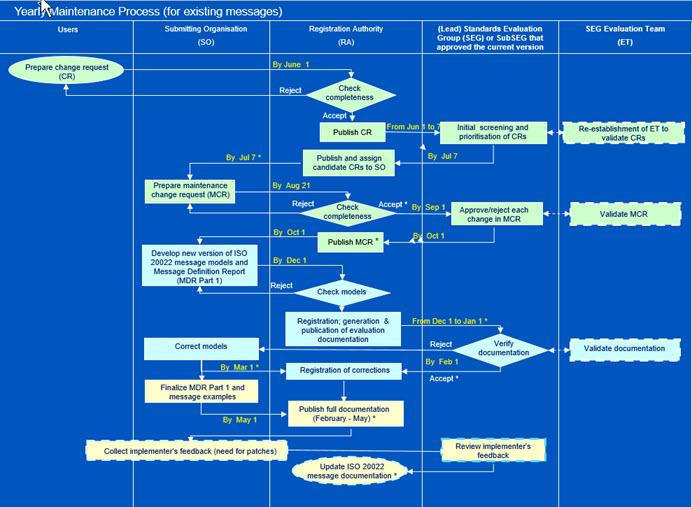
Existing ISO 20022 messages can be updated on a yearly basis provided changes are requested by the users and approved by the Standards Evaluation Groups (SEGs). New versions of messages, if any, are published in April/May of each year. Change requests for the following yearly cycle must be introduced prior to the 1st of June of the preceding year.
In certain circumstances such as urgency or where required by the relevant business community, it is possible to request the maintenance of ISO 20022 messages outside of the yearly cycle.
The SEG, which represents the message users, is responsible for approving both the change request and the timing of publication of the new message version. It is important to note that the publication of a new version in the Catalogue of messages does not mandate users to implement it. Actual implementation of new versions and the migration conditions ('big bang' or migration preceded by a period of coexistence) are not governed by ISO, but by the communities of users and implementers. However, frequent publication of new versions of the same set of messages should be avoided to ensure the stability expected by users and implementers. If a message is updated continuously, potential users may tend to wait until it is stabilised to invest in its implementation.
The maintenance process includes the following steps:
Actual or potential users of ISO 20022 messages are welcome to forward their requests for changes to the Registration Authority (RA). Each change request must describe the scope of the change including the list of impacted ISO 20022 messages as identified by the requester, the purpose of the change, the community of users interested by the change and the urgency and expected benefit/impact of the proposed change on current or future users. If the change is proposed to be implemented outside the yearly schedule, the change request must include the justification thereof. A change request template is available from the ISO 20022 website.
Change requests must be sent to the Registration Authority at iso20022ra@iso20022.org. The RA checks each change request for completeness and conformance to the change request template.
When the change request is valid (that is, conforming to the change request template), the RA returns a positive acknowledgement to the submitter, publishes the change request in the Catalogue of change requests and forwards it to the Standards Evaluation Group (SEG) which had approved the current version of the identified ISO 20022 messages.
Valid change requests must be received by the RA prior to June 1 to be considered for implementation in the next yearly maintenance cycle.
Note: when the current version of the messages had been approved by several SEGs under the leadership of a Lead SEG, the RA forwards the request to the Lead SEG and copies the other SEGs.
Change requests are evaluated by the SEG which approved the current version of the impacted messages on behalf of the community of users. The purpose of the initial evaluation is to filter change requests and already reject those that are not justified.
The RA forwards change requests to the SEGs on an ongoing basis. All valid change requests received by the RA prior to June 1 are communicated to the SEGs by June 7 at the latest. The SEGs are invited to evaluate change requests as soon as received and to contact the submitter at the earliest possible moment with any queries as to scope, purpose or other points of clarity. If an Evaluation Team was established by a SEG to evaluate the current version of the messages, the SEG may re-establish this Evaluation Team and ask for their expert opinion on the rationale for each requested change. The submitting organization that developed the current version of the messages is also invited to participate in the initial evaluation. When several organizations share the IPR of the current version of the messages, all of them are invited to participate in the initial evaluation.
The SEG updates the change request forms with its recommendation to consider or not the request. If the request is accepted for further consideration, the SEG indicates whether it believes the implementation timing proposed by the submitter (whether in or outside of the yearly cycle) is reasonable. The SEG gives a reason for the change requests it recommends rejecting. The SEG forwards all completed change request forms to the RA by July 7 for publication in the Catalogue of change requests.
Although the submitting organization in charge of the maintenance of the impacted messages is involved in the initial evaluation, the RA officially communicates all change requests approved for further consideration by the SEG by July 7 to the submitting organization in charge.
Note: in general, new versions of messages will be developed by the original submitting organization, that is the organization that developed the original version of the messages. If, for any reason, the original submitting organization cannot perform all or part of the requested changes, the RA and the SEG will seek an alternative submitting organization ready to maintain the messages. The SEG may also agree to postpone all or part of the requested changes.
The RA assists the submitting organization in setting up the required development environment, provides necessary electronic versions of the ISO 20022 Data Dictionary and copies of the current version of the ISO 20022 models.
The submitting organization prepares a Maintenance Change Request which includes all the change requests approved for further consideration by the SEG and indicates, for each of them, how the submitting organization proposes to implement the change and the resulting impact on the targeted messages. The Maintenance Change Request also confirms whether or not the submitting organization can dedicate required resources to the development of the changes in the requested timeframe. If, for any reason, the submitting organization cannot perform all or part of the requested changes, the RA and the SEG will seek an alternative submitting organization ready to maintain the messages. Alternatively, the SEG may agree to postpone all or part of the requested changes.
The submitting organization sends the Maintenance Change Request to the Registration Authority (RA) at iso20022ra@iso20022.org where the Maintenance Change Request is logged, checked for completeness and confirmed to the submitting organization. From this point on, the status of the Maintenance Change Request is tracked in the Status of submissions which includes a copy of the latest version of the Maintenance Change Request.
Valid Maintenance Change Requests for the following yearly maintenance cycle must be received by the RA by August 21 and are forwarded, by September 1, to the SEGs which had performed the initial evaluation of the change requests.
The SEG - or its Evaluation Team - reviews the Maintenance Change Request and approves the proposed implementation of each change request.
The submitting organization is invited to participate in the evaluation to give any further clarification regarding the proposed updates.
The result of the review is an agreement regarding which changes will be implemented, how and when. The SEG updates the Maintenance Change Request with its decision for each of the proposed changes and forwards the updated document to the RA. The SEG has until October1 to complete the review of the Maintenance Change Request and forward it to the RA.
Upon their receipt, the RA transmits the completed Maintenance Change Requests to the submitting organizations and posts them in the Status of submissions.
For the yearly maintenance cycle, the submitting organization has until December 1 to develop a new ISO 20022 compliant version of the message models, which includes the changes approved by the SEG, and get it checked for compliance by the RA. For exceptional unscheduled changes, the timeframe is indicated in the approved Maintenance Change Request.
The RA registers the candidate new version of ISO 20022 messages and generates the evaluation documentation. The evaluation documentation includes a copy of the message models, the XML schemas and a preliminary Message Definition Report generated from the message models.
The evaluation documentation is distributed to the SEG during December.
The SEG - or its Evaluation Team - has until February 1 to verify that the new version of the messages actually reflects the approved changes, as agreed. If it is not the case, the submitting organization has until March 1 to correct the models or documentation as appropriate.
Upon approval of the SEG, the RA officially notifies the submitting organization and the RMG of the newly approved version of ISO 20022 messages'. It is only after the approval by the SEG that the new candidate ISO 20022 messages can be called 'ISO 20022 messages' (or ISO 20022 compliant messages).
Upon approval by the SEG, the submitting organization prepares additional information to allow the RA to publish the full documentation of the new version of the messages. This includes contextual documentation to introduce the new transaction flow and/or illustrate the message usage, and, possibly, examples of XML message instances. This additional information must be received by the RA no later than May 1.
In April/May, the RA publishes the new versions of the ISO 20022 messages on the ISO 20022 website. This includes:
During the entire registration process, the RA keeps the status of all Change Requests and Maintenance Change Requests updated in the Catalogue of change requests and Status of submissions respectively.
Until the newly published messages have been tested or implemented, one cannot fully guarantee that:
If and when the RA is informed that the updated messages have been implemented, it will indicate it in the Catalogue of messages. The submitting organization is also invited to review the published documentation and organize or encourage testing and implementation of the new version of the messages.
The submitting organization, testers or first implementers are invited to communicate to the RA any remarks they have on the published documentation. The remarks may include proposals for changes to clarify the documentation, align it with what was approved by the SEG, eliminate ambiguity or correct errors that prevent implementation of the updated messages. They may include proposals to make the new version easier to implement or process, but may normally not include new business requirements, unless (1) they are in the scope of the approved maintenance change request, and (2) the SEG, the RA and the submitting organization jointly agree that the proposed changes can and must be implemented as soon as possible to ensure adoption of the new version.
If a correction of the messages and/or documentation is approved, the new publication is clearly announced on the ISO 20022 website and an 'errata' with the list of the changes is published by the RA for the convenience of implementers who would have started using the published version of the messages/documentation. If the messages have been 'patched' to correct a mistake (the messages did not reflect what the SEG had approved) or an error (the schema was invalid), the corrected schemas bear a new generation timestamp but keep the same message version number. If any other change is made to a message (improvement, new requirement), the message version number is increased.
According to the ISO 20022 Intellectual Property Rights policy, the submitting organization keeps the IPR on the updated messages although it grants third parties a non-exclusive, royalty-free license to use the published information. When there are several submitting organizations, for example when the submitting organization of a new version is not the same as the submitting organization(s) of the previous version(s) of the messages, all submitting organizations will share the IPR.
Submitting organizations may appeal to the RMG against a decision of the RA or a SEG using the Appeal/Issue template. A subsequent appeal may be made through the secretariat of ISO TC68, the ISO committee in charge of the ISO 20022 standard.
Complaints regarding the service provided by the RA or the SEGs may also be sent to the RMG using the Appeal/Issue template. Complaints must be service orientated and are not considered part of the appeal process.